
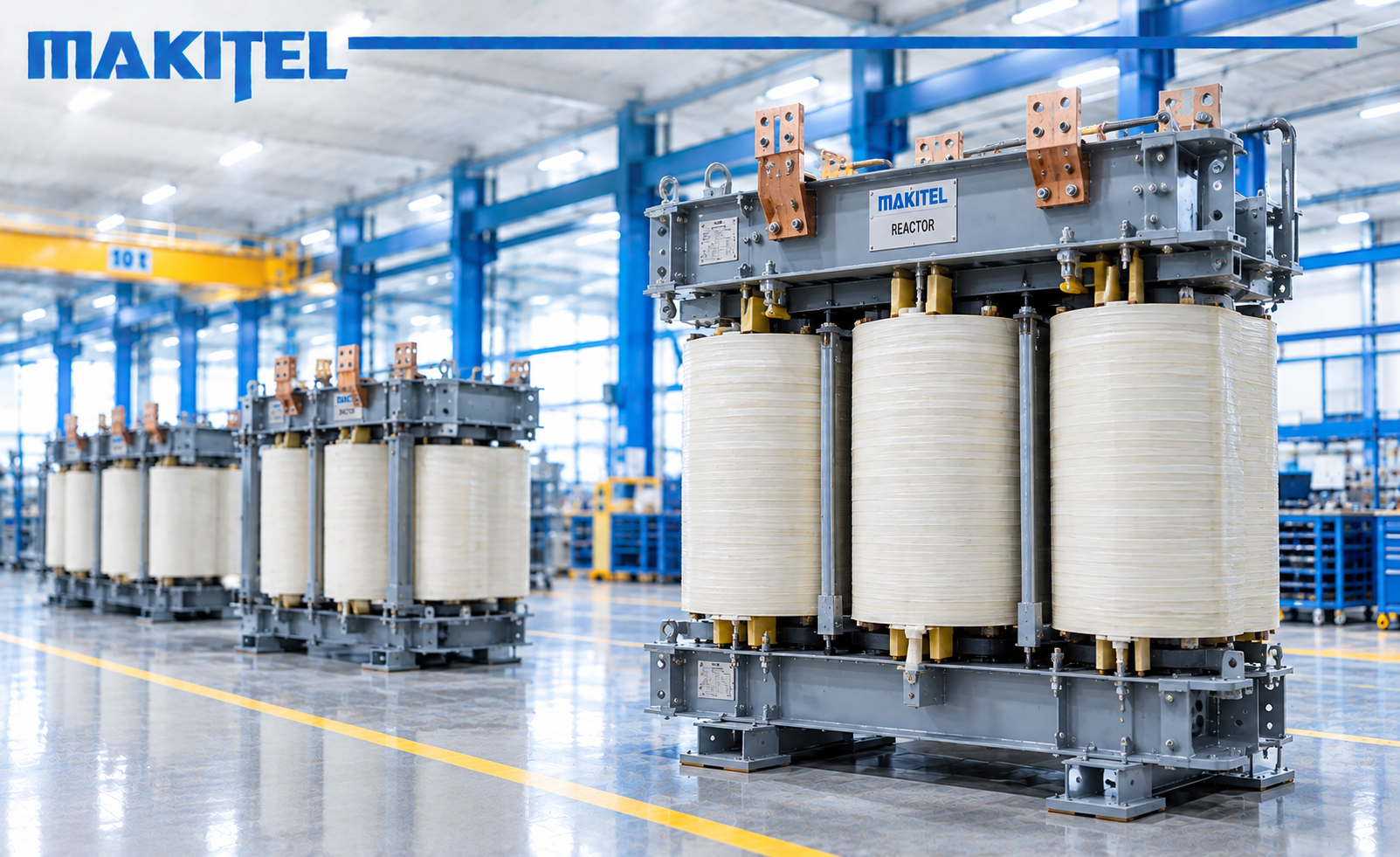
The production facility of the renowned Macedonian manufacturer MAKITEL DOOEL delivers sophisticated, custom-engineered multi-secondary rectifier transformers. Designed for heavy industrial applications like aluminum electrolysis, chemical plants, arc furnaces, and high-power DC drives, these units provide critical electrical isolation while naturally eliminating destructive high-frequency harmonics at the primary source.
To achieve clean power, MAKITEL utilizes multi-pulse configurations where multiple secondary windings are wound on the same core leg with precise phase angle shifts (α = 60° / k). For standard 12-pulse systems, MAKITEL builds three-winding transformers with a natural 30° phase shift achieved by combining Star (Y) and Delta (Δ) secondary vector groups (e.g., Dy11d0).
This configuration mathematically cancels out the disruptive 5th and 7th harmonics on the primary side. For highly critical lines requiring full physical redundancy, they also offer two-transformer setups split into independent Δ-Δ and Δ-Y units fed from the same busbar.
For mega-watt scale plants requiring stricter compliance with international harmonic standards, MAKITEL engineers advanced 24-pulse systems featuring four independent secondary outputs shifted by exactly 15°. This ultra-precise shift is achieved using either extended delta primaries (which introduce an initial ±7.5° angle shift) or Zig-zag (Z) secondary windings, where winding segments are split and interconnected across different core legs to fine-tune the output angles.
For the most demanding, ultra-clean power environments or high-capacity chemical electrolysis, MAKITEL scales this technology up to 48-pulse systems requiring eight secondary outputs shifted by 7.5°, reducing total harmonic current distortion (THDi) to well below 2%.
To withstand the harsh thermal and mechanical demands of non-linear rectifier loads, every MAKITEL unit is engineered with high inter-winding decoupling to ensure perfectly balanced short-circuit impedance Zsc across all secondaries. Combined with continuously transposed conductors (CTC) to lower eddy current losses and heavy mechanical clamping, these multi-winding systems deliver maximum structural longevity, minimal load losses, and full compliance with international ISO and IEC standards.